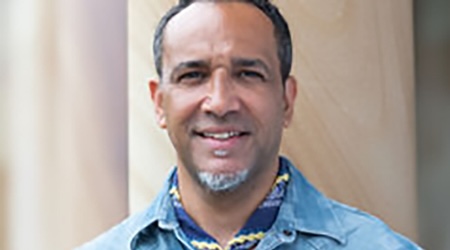
Al Harvey is of Saibai Island descent and has recently joined the Language Data Commons of Australia (LDaCA) as an Industry Fellow. He is currently completing his PhD at The University of Queensland, documenting a cultural framework of Saibai Island, and serves as a Partner Investigator on the ARC Discovery project "Torres Strait Islander History: Sport, Culture and Identity" (2023–2025). Al previously led the "Saibai Island Language and Cultural Knowledge Project", for which he received a Discovery Australian Aboriginal and Torres Strait Islander Award (DAATSIA). We interviewed Al about his work with language and cultural materials, community archives and how LDaCA can support this space.
Can you tell us a little about your background and what drew you to working with language and cultural materials?
My father is from South London in England, and my mother was born on Saibai Island. Following an extreme king tide event in the 1940s that inundated garden beds and freshwater sources on Saibai, she later migrated with the Koey Buway tribe to the Northern Cape York Peninsula, where they established the Saibai satellite communities of Bamaga and Seisia. My professional background spans more than 30 years across education, Indigenous community programs, research, sport, recreation and health, with a consistent focus on strengthening Indigenous people, culture and place.
My pathway into language and cultural materials began with my upbringing. Our family lived mainly in Roma, Western Queensland, but we regularly visited family in Brisbane and Bamaga. As a young boy, I was fascinated by how naturally my mother moved within extended family gatherings. Her comfort and confidence in these settings were noticeably different from her experience navigating the Western world. I later understood that this confidence came from a deep familiarity with Saibaian ways of relating: knowing how to speak with people, understanding family responsibilities, and participating in systems of sharing, care and reciprocity. This sparked my curiosity about how language and culture shape identity, belonging and connection.
Through later work in remote Pitjantjatjara and Torres Strait communities, I came to see language as inseparable from governance, knowledge and community life. I also witnessed, within my lifetime, the dramatic decline in fluent Saibai language speakers and, with that, changes in how we relate to one another. I saw the effects of the imposition of Western economic, governance and education systems on Saibai’s social, cultural and economic structures. Elder Saibaians and Saibaian leaders have continually responded by resisting, adapting, negotiating and working with Western institutions to varying degrees of success. Any work I undertake today is built on the foundations of those efforts.
Can you tell us more about the Saibai Island Language and Cultural Knowledge Project you’ve been working on throughout your PhD?
My PhD focuses on describing a Saibai Island language and cultural framework. This involves working with Saibai Elders, knowledge holders and community members to recover, organise and recontextualise both new and dispersed archival materials relating to Saibai language, cultural structures and history.
A key driver has been concern about the declining Saibaian speaker base of Kalaw Kawaw Ya (KKY), the traditional language of Saibai and neighbouring western Torres Strait communities. Elders have noted that fluent first-language speakers are passing away and are not being replaced by a new generation of first-language speakers. For them, this is about more than language loss. It affects the transmission of cultural knowledge, family responsibilities, environmental understanding and the wisdom that has guided Saibaian life for generations.
I worked closely with the late Mr Dana Ober, a respected Saibai Island Elder, fluent KKY speaker and professional linguist who dedicated much of his life to documenting and strengthening Saibai language and cultural knowledge. The project builds on foundations laid by Mr Ober and many Elders before him. It has included archival research, community consultation, new recordings with senior Saibai people, and the development of a digital database and website, both of which are still under development and not yet available to the broader Saibai community.
A major aim is to locate both new and archival materials within a Saibai Island cultural framework so that they make contextual sense from a Saibaian perspective and way of being in the world. Rather than treating records as isolated items, the project explores how they can be understood within a broader Saibai cultural context. It is therefore concerned with preservation, future access, intergenerational learning and community authority over cultural knowledge.
What is a community archive? How do community archives differ from mainstream institutional archives?
A community archive is shaped by the people whose knowledge, history and cultural materials it contains. Its purpose, organisation and access arrangements are guided by community priorities, relationships and cultural responsibilities.
Major collecting institutions have played an important role in preserving materials that might otherwise have been lost. However, their systems have generally been designed around institutional priorities and classification frameworks. Community archives create opportunities to organise and interpret materials through Indigenous languages, cultural categories and community relationships.
This matters because Indigenous language and cultural materials are part of living traditions. Western archives often organise material through collector names, accession numbers, object types or broad subject categories. Community archives may instead organise material through family connections, language groups, island affiliations, places, stories, songs or cultural responsibilities. The key difference is that community archives prioritise community meaning and authority.
Why do you think community-led archives are important?
Community-led archives allow communities to engage with archival materials on their own terms. For Indigenous communities, archives can contain ancestral voices, language recordings, family histories, cultural teachings and evidence of enduring connections to place.
When communities lead the organisation and interpretation of these materials, they can provide context that may be absent from institutional records and ensure knowledge is represented in culturally meaningful ways. Community-led archives can support language revitalisation, cultural continuity, intergenerational learning and identity, while keeping communities central to decisions about their own knowledge.
How do the communities you work with engage with archival materials? Has this influenced your approach to your archiving project?
The Saibai community engages with archival materials relationally rather than simply informationally. People often want to know who is speaking, which family they belong to, where a recording or photograph was made, what language or area of knowledge is being used, and what cultural context surrounds it.
This reflects an understanding that knowledge exists within networks of relationships. A recording may represent an Elder, a family history, a place or a cultural practice, and those connections are often as important as the item itself. This has shaped my approach: rather than treating archival materials as disconnected files, we focus on reconnecting them with people, place and cultural context through meaningful metadata, cultural links and community guidance.
How do you see Indigenous data governance shaping the way we work with language and cultural materials?
Indigenous data governance recognises that language and cultural materials remain connected to the communities they come from. Rather than focusing only on information management, it emphasises authority, responsibility and cultural protocols.
It asks: Who has the right to make decisions about this material? Who should have access? What cultural considerations apply? How should knowledge be represented? What should remain restricted? How can benefits flow back to the community? These questions help ensure that digital systems, research practices and access arrangements respect cultural connections.
At the same time, the intersection of Indigenous and Western data governance structures remains challenging. This challenge is underpinned by ongoing power imbalances. While there are many well-intentioned efforts to reform outdated systems, meaningful change within large institutions is often slow and constrained by lengthy policy and political processes. Unfortunately, these delays are occurring at a time when many Elders who can interpret and contextualise archived language and cultural materials are passing away.
What does Indigenous data governance look like in your project?
What is often described in Western contexts as Indigenous Data Governance is understood by Saibaians through the principle “Saibailgaw za ngaru Saibailgaw za” - Saibai things belong to Saibai people.This phrase encapsulates the enduring relationship between Saibai people and all that is of Saibai, including language, knowledge, stories, cultural materials, land, seas, celestial bodies, winds, and archival records, regardless of where those 'things' are physically held.
Different things carry different cultural responsibilities. Some may be appropriate for broad access, while others may require restrictions informed by family, clan, gender, ceremonial, spiritual, or other cultural obligations. In practice, this includes culturally appropriate consent, attribution, metadata, community review, and the use of Saibai language categories and knowledge systems wherever possible. Rather than imposing an external governance framework, the guiding principle for all things of Saibai remains Saibailgaw za ngaru Saibailgaw za.
Are there particular challenges or opportunities you see when supporting community archives?
One challenge is ensuring community archives have the long-term support needed to remain sustainable, including funding, technical infrastructure, training, governance processes and ongoing community involvement. Communities also need time to make careful decisions about cultural protocols and access.
Another challenge is ensuring digital systems can accommodate Indigenous ways of organising knowledge. Many existing platforms were not designed to reflect the complexity of relationships between people, place, language and culture. At the same time, community archives can make important materials more accessible and meaningful, supporting language maintenance, cultural education and intergenerational learning. They can also strengthen partnerships between communities, researchers, collecting institutions and infrastructure providers.
What led you to join the LDaCA team?
I joined LDaCA because its work closely aligns with the issues I have been exploring through the Saibai Island language and cultural documentation work I am involved in. My research has highlighted the importance of not only preserving language materials but ensuring they remain meaningful and useful to the communities they relate to.
LDaCA is developing national infrastructure for language data, and I saw an opportunity to contribute a Saibaian perspective to its design and governance. I am particularly interested in how digital systems can better support community authority and cultural context.
What excites you most about the work LDaCA is doing in this space?
What excites me most is the opportunity to bring together technical infrastructure and Indigenous approaches to knowledge governance. Beyond simply returning archival material to Indigenous communities, the real work, for me, lies in exploring how the complex and interactive nature of systems, entities and cultures can be reflected as effectively as possible within technical infrastructure.
There is enormous, as-yet-unrealised potential to develop systems that do more than store language materials. They can help communities, institutions and society more broadly understand and adapt our systems and structures in ways that benefit everyone.
The concerns expressed by Saibai Elders are shared by many Torres Strait and Aboriginal communities across Australia. Communities are looking for practical ways to strengthen language transmission, maintain cultural knowledge and support future generations. LDaCA can help build the tools, workflows and partnerships needed to support these goals while embedding Indigenous perspectives within language infrastructure from the outset.
Looking ahead, where do you see LDaCA making the biggest impact in supporting communities and their language materials?
I think LDaCA can make its biggest impact by helping communities move beyond the simple transfer of archival materials towards greater authority and long-term stewardship of their language and cultural materials in ways that reflect their own worldviews and ways of being.
This includes supporting community-held collections, strengthening connections between institutional and community archives, and developing systems that enable materials to be organised and described using Indigenous languages and cultural frameworks.
LDaCA can also help support broader community aspirations that extend beyond preservation to strengthening cultural identity, supporting language transmission and maintaining connections between generations. For communities like Saibai, the long-term goal is not simply to safeguard records of the past, but to ensure that language and cultural knowledge continue to play an active role in shaping community futures.